
Ieyasu and Edo
Tokugawa Ieyasu was appointed shogun in 1603. He governed from Edo, a castle town on the eastern plain that is now Tokyo. Two years later he passed the title to his son Hidetada, keeping the real power himself, as a signal that the title would stay in his family. The sieges of Osaka Castle in 1614 and 1615 destroyed the last of the Toyotomi, and Ieyasu died the following year.
Holding the country together
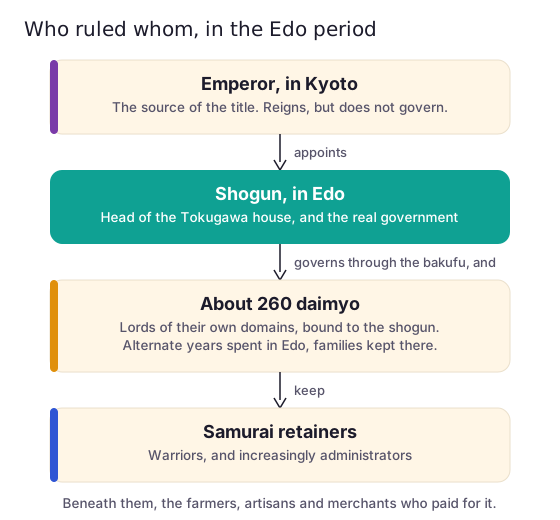
The shogun ruled the lands of his own house directly, and about 260 daimyo held their own domains, called han, on his terms. They were moved, rewarded and punished at his will, and they could not marry, build castles or make alliances without leave.
Under the rule of alternate attendance, sankin-kōtai, formalised in 1635, each daimyo spent every other year in Edo and left his wife and heir there when he went home. The great processions to and from the capital were ruinously expensive, which was part of the point.
A closed country
The shogunate controlled contact with the outside world. Christianity was banned and its followers persecuted, the Portuguese were expelled in 1639, and from 1641 the only Europeans allowed to trade were the Dutch, confined to the small artificial island of Dejima in Nagasaki harbour. Trade continued with China, and with Korea, the Ryukyu kingdom and the Ainu through the domains that bordered them.
The long peace
In peace the samurai became administrators, and Edo grew into one of the largest cities in the world, with more than a million people by the eighteenth century. Its merchants and townspeople made their own culture: kabuki theatre, the puppet theatre, and the woodblock prints of the floating world.