The book
- Author
- James Clavell
- Published
- 1975, by Delacorte Press in the United States and Hodder & Stoughton in the United Kingdom
- Length
- About 1,150 pages in the first paperback
- Set in
- Japan, in 1600
- Series
- The Asian Saga, of which it was the third to be published
- Sales
- Six million copies worldwide by 1980
Shōgun is historical fiction: a long, detailed novel of politics, war, religion and trade, told largely through the eyes of an Englishman who understands none of what he sees at first. It follows the end of the age of the unifiers and the beginning of the Tokugawa shogunate, and its central question is who will rule Japan after the death of the Taikō.
The author
James Clavell was born in Sydney in 1921, the son of a Royal Navy officer, and served as an officer in the Royal Artillery in the Second World War. He was captured in the Dutch East Indies and held as a prisoner of war by the Japanese, including at Changi Prison in Singapore. His first novel, King Rat, drew on that experience.
Before Shōgun he had a career in Hollywood as a screenwriter and director. He wrote the screenplays for The Fly in 1958 and The Great Escape in 1963, and wrote and directed To Sir, with Love in 1967. He became an American citizen in 1963, lived for many years in Vancouver, and died in Switzerland in 1994.
The story
This describes the opening only. The ending is left for you to read.
The Dutch ship Erasmus, her crew dying, is driven ashore on the coast of Japan. Her English pilot major, John Blackthorne, is taken prisoner. He is a Protestant, and the Portuguese traders and Jesuit priests who already have a foothold in Japan regard him as a heretic and an enemy.
Japan is ruled by a council of five regents on behalf of the dead Taikō’s young heir. The two most powerful of them are Lord Toranaga, lord of the Kanto, and his rival Lord Ishido. Toranaga sees that the stranger may be useful. Blackthorne is interpreted for by Lady Toda Mariko, a Catholic convert loyal to Toranaga, and slowly, painfully, he learns the language and the customs of a country he at first thinks barbarous, and is given a Japanese name, Anjin, the pilot.
The real people
Clavell changed the names, and moved and compressed events freely, but almost every main character has a real model. The pairs below are the ones usually given.
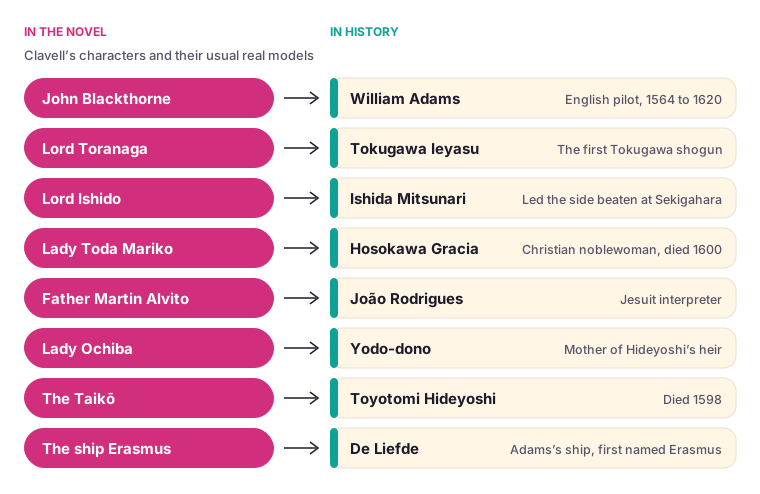
William Adams was an English pilot in a Dutch fleet. His ship, De Liefde, which had first been called Erasmus, reached Kyushu in April 1600 with most of her crew dead. Adams was taken to Tokugawa Ieyasu, won his trust, built ships for him, and was made a samurai with an estate near Edo. He was never allowed to go home, and died at Hirado in 1620. In Japan he is remembered as Miura Anjin.
Tokugawa Ieyasu, Toranaga’s original, went on to win at Sekigahara and found the last shogunate. Hosokawa Gracia, the model for Mariko, was a Christian noblewoman, the wife of one of Ieyasu’s generals, who died in 1600 during the struggle with Ishida Mitsunari.
Clavell’s Blackthorne arrives in Izu rather than Kyushu, and the village of Anjiro is invented. The novel stops short of the great battle itself.
The Asian Saga
Shōgun is one of six novels Clavell set in Asia. Its story is the earliest, but it was the third to be published.
| Novel | Published | Set in |
|---|---|---|
| King Rat | 1962 | Changi, 1945 |
| Tai-Pan | 1966 | Hong Kong, 1841 |
| Shōgun | 1975 | Japan, 1600 |
| Noble House | 1981 | Hong Kong, 1963 |
| Whirlwind | 1986 | Iran, 1979 |
| Gai-Jin | 1993 | Japan, 1862 |
The book has been adapted twice for television, and also as a stage musical, a board game and video games.